驱动精灵
China rejects EU’s ‘unlawful’ extraterritorial overreach in JD.com probe; move signals Beijing’s resolve to safeguard its interests: expert_我的网站

A |

China's Ministry of Justice Photo: VCG
China on Wednesday determined that the EU's cross-border investigative practices targeting Chinese entities in its probe into JD.com under the Foreign Subsidies Regulation (FSR) constituted unlawful extraterritorial jurisdiction, and said it is barring organizations and individuals from implementing or assisting with the measures.
This statement was made by China's Ministry of Justice (MOJ), together with the Ministry of Commerce (MOFCOM) and other relevant departments. The announcement takes effect immediately.
The finding follows an investigation conducted pursuant to Articles 3 and 6 of China's rules on countering foreign states' unlawful extraterritorial jurisdiction measures. No organization or individual may implement or assist in implementing such measures, according to the official WeChat account of the MOJ on Wednesday evening.
The announcement sends a clear and firm message about China's position on the EU's unilateral measures, and the bloc should carefully weigh the broader implications of pursuing such actions, including the potential costs to its own interests and China-EU economic and trade relations, a Chinese expert said. Continued use of the FSR in this manner could erode investment confidence and further strain bilateral economic ties, the expert noted.
Countering extraterritorial overreachA spokesperson for China's MOJ on Wednesday blasted the EU's targeting of JD.com, saying the bloc had arbitrarily demanded extensive and unnecessary information located in China from Chinese entities on a cross-border basis. Such demands are improper and constitute a serious violation of the international rule of law, the spokesperson said.
To safeguard China's sovereignty, security and development interests, as well as the legitimate rights and interests of Chinese citizens, legal persons and other organizations, the Ministry of Justice, together with the Ministry of Commerce and other relevant authorities, determined in accordance with rules on countering foreign states' unlawful extraterritorial jurisdiction measures that the EU's actions constituted unlawful extraterritorial jurisdiction. Any organization or individual is therefore prohibited from complying with or assisting in the implementation of the measures, according to the spokesperson.
The MOJ spokesperson urged the EU to immediately correct its wrongful practices, stop abusing the Foreign Subsidies Regulation as an investigative tool, and provide a fair, just and predictable market environment for companies investing and operating in Europe. If the EU persists with such actions, China will take resolute countermeasures in accordance with law, the spokesperson said.
Chinese e-commerce giant JD.com's $2.5 billion bid for German electronics retailer Ceconomy may involve Chinese subsidies, European Union competition regulators claimed, as they opened a full-scale investigation into the deal, Reuters reported on May 28.
The acquisition will allow one of China's largest retailers to expand outside its home market via Ceconomy-owned electronic products retailers MediaMarkt and Saturn, Reuters reported.
The decision by the European Commission marks its first in-depth probe of a Chinese deal under its so-called FSR.
This marks another time the rules on countering foreign states' unlawful extraterritorial jurisdiction measures have been invoked since they took effect in April.
In May, the MOJ, together with MOFCOM and other relevant departments, determined after an investigation that the EU's cross border investigative practices targeting Chinese entities in its investigation into Nuctech under the FSR constituted unlawful extraterritorial jurisdiction.
The latest announcement concerning the EU's unilateral move under the FSR once again reflects the Chinese government's firm position on safeguarding national sovereignty, security and legitimate rights and interests, while also representing a clear response to the EU's relevant practices, Jian Junbo, director of the Center for China-Europe Relations at Fudan University's Institute of International Studies, told the Global Times on Wednesday.
"The announcement sends a clear signal to the EU and other countries: China will not accept attempts by any country to use its domestic laws as a basis for exercising unlawful extraterritorial jurisdiction over matters within China, particularly when such actions undermine China's sovereign rights and interests," said Jian.
Likewise, China will not accept attempts to unilaterally address economic and trade frictions through so-called legal instruments when doing so harms the legitimate rights and interests of Chinese companies and the Chinese market, Jian said.
Call on fair, just marketThe EU's frequent use of the FSR against Chinese companies is not an isolated occurrence.
In February, the European Commission announced an in-depth investigation under the FSR into Chinese wind turbine manufacturer Goldwind.
Responding to the bloc's move, a MOFCOM spokesperson said that the EU had recently frequently used the FSR to launch investigations into Chinese companies and had escalated investigations into Chinese wind power and security equipment companies to in-depth probes, showing clear targeting and discrimination. China has expressed serious concern and strong dissatisfaction over the moves.
The MOFCOM spokesperson said the EU's investigations had broadened the concept of "foreign subsidies" and involved multiple problems, including insufficient evidence to launch investigations and a lack of transparency in procedures, describing the practices as "typical protectionism in the name of 'fair competition.'"
In January 2025, following an investigation, MOFCOM already determined in accordance with the law that the EU's relevant practices constituted trade and investment barriers. Instead of correcting its practices, the EU has gone further down the wrong path.
"China has made its position very clear, and the EU should fully consider the consequences of continuing with such measures, including their potential impact on the EU itself and on China-EU economic and trade relations," Zhang Jian, a vice president of the China Institutes of Contemporary International Relations, told the Global Times on Wednesday.
If the EU continues to impose excessive restrictions on foreign companies through similar rules, it will not only raise compliance costs for multinational companies but could also undermine the competitiveness of European businesses, Zhang said, noting that the EU economy is already facing considerable challenges, while concerns over excessive regulation, bureaucracy and increasingly complex rules have also grown within Europe.
Moreover, such rules may ultimately constrain European companies as well as foreign businesses, experts noted. At a time when the EU economy is facing difficulties, adding more regulation and restrictions instead of addressing underlying problems would be akin to "drinking poison to quench thirst," potentially creating even greater problems for the European economy, Zhang said.
China and the EU are both major global economies. Chinese investment in Europe not only brings capital, but also creates jobs, strengthens supply chains, introduces new technologies and adds vitality to local markets, Jian said.
Moreover, from new-energy vehicles to air conditioners and other consumer products, Chinese companies have brought high-quality, cost-effective products to European consumers, helping meet much-needed market demand while providing consumers with greater choice.
Jian said that as China-EU cross border investment deepens, regulatory frictions are inevitable, but they should be addressed through dialogue and coordination rather than unilateral expansion of extraterritorial jurisdiction. Respect for each other's judicial sovereignty and legal boundaries is essential to stable and predictable economic and trade ties, the expert said.
。
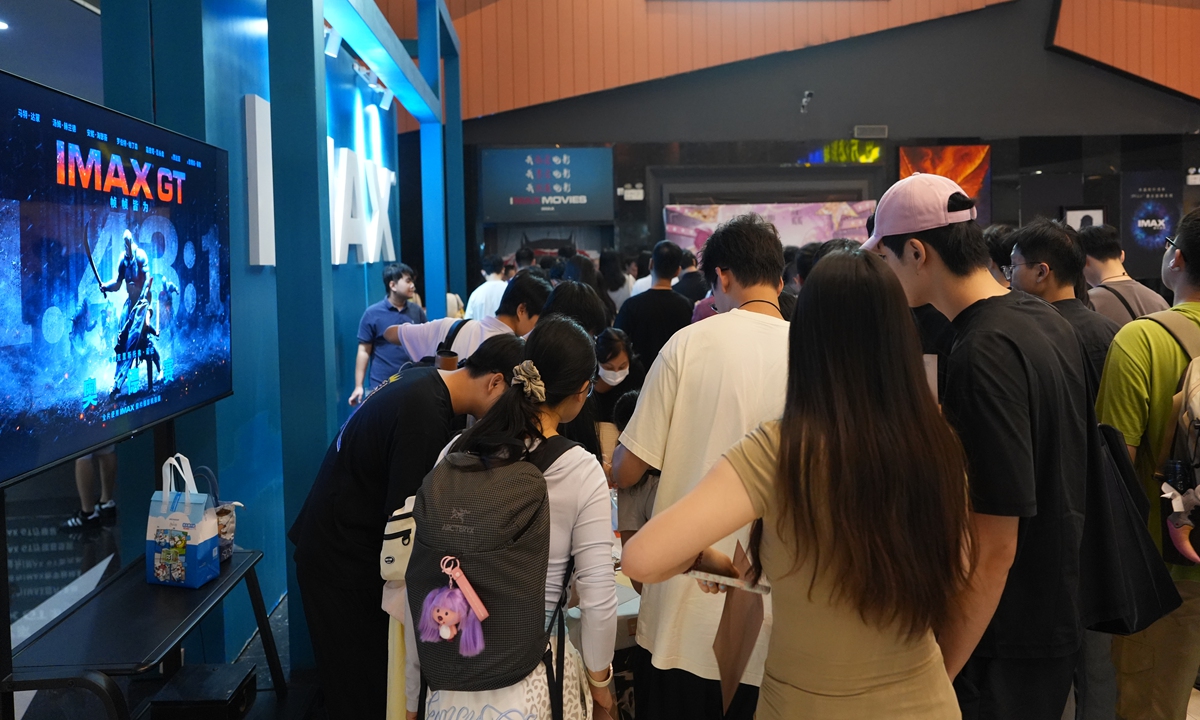
Moviegoers line up at a IMAX ticket hall in Dongguan, South China's Guangdong Province, on August 15, 2026. Photo: VCGChristopher Nolan's much-anticipated
The Odyssey officially opened in China on Friday, quickly becoming one of the hottest tickets of the summer movie season, with moviegoers scrambling for premium IMAX screenings and some even traveling to other cities for better viewing experiences with better screens.
Meanwhile, domestic hit
Once Upon a Time in the Middle East has grossed more than 850 million yuan ($126 million), adding to the intense competition for audiences during China's packed summer movie season.
The Odyssey, which had already held limited previews in China, had grossed an estimated 240 million yuan as of Sunday, according to ticketing platform Maoyan. Its projected box office is expected to surpass 700 million yuan, potentially exceeding the 452million yuan
Oppenheimer grossed in the Chinese mainland.
The Odyssey is the first feature film shot entirely using IMAX cameras and is being presented in IMAX 70mm at select theaters. Its large-format cinematography and expansive visual style have made the IMAX experience a major selling point for Chinese moviegoers.
Demand for premium IMAX screenings was already intense during the film's previews, with some theaters reporting full occupancy. After its official release, that enthusiasm has shown no sign of easing.
In Beijing, one longtime Nolan fan had been following the film since before its release and had repeatedly tried to secure a seat at the China National Film Museum's IMAX GT theater, one of the most sought-after formats for the movie.
Unable to get a ticket, the moviegoer eventually chose another well-reviewed IMAX theater and paid 180 yuan for a seat, three times the price of a normal seat, that was not particularly well positioned.
The theater was nearly full when the audience arrived, the moviegoers were largely quiet as they waited for the screening to begin. But the large-format presentation delivered the immersive audiovisual experience the audience had been anticipating.
Another moviegoer, Lin Xiao, managed to attend an IMAX screening during the previews and also noted the high attendance. She told the Global Times that audiences had already formed a long line outside the theater before the movie began.
On Chinese lifestyle platform Xiaohongshu, or RedNote, some moviegoers have posted about traveling to other cities because their hometowns do not have IMAX GT screenings. Some have even taken high-speed trains specifically to watch
The Odyssey in what they consider a better theater.
Zhang Peng, a cultural researcher and associate professor at Nanjing Normal University, told the Global Times that
The Odyssey's strong reception and high attendance in China demonstrate that high-quality content, combined with the rare and highly immersive experience offered by premium formats such as IMAX GT, remains a key competitive advantage for cinemas.
The film's strong quality, coupled with its cutting-edge large-format presentation, creates a theatrical experience that cannot be easily replicated at home, showing that when cinemas can offer a sufficiently distinctive immersive experience, the big screen retains its unique social and ceremonial appeal, with audiences willing to pay a premium for such exclusivity, said Zhang.
However, film critic Liu Nandou offered a restrained forecast, predicting its Chinese mainland gross at 300 million to 800 million yuan ($41 million to $110 million).
"Nolan's films have a ceiling," he told the Global Times in a previous interview. "The threshold for understanding
The Odyssey is extremely high, and it doesn't fit the broad popcorn audience."
The appeal of premium formats is not limited to
The Odyssey. Several films in China's summer movie season have also embraced IMAX and other high-end formats, giving audiences more options for immersive theatrical experiences.
Once Upon a Time in the Middle East, which has grossed more than 850 million yuan at the box office and is projected to surpass 2.5 billion yuan, according to Maoyan, was specially shot for IMAX.
Rather than relying on grand battle scenes, the film is set almost entirely in a small Chinese restaurant in war-torn Iraq in 2003. Played by Shen Teng, Xu Fu is a chef looking to make a living abroad and find a quiet life. But when war suddenly erupts, he and restaurant manager Ma Junsheng, played by Jiang Qiming, choose to keep the kitchen running, serving authentic Chinese dishes and creating a safe haven for local civilians and children amid the chaos.
The film uses IMAX's large screen to present the warmth of everyday life and the details of the restaurant with greater clarity and immersion.
The Odyssey, meanwhile, uses IMAX film cameras to bring the epic scale of Homer's poem to the big screen with sweeping and visually striking imagery. All Wishes Come True! is also available in premium formats including IMAX, Dolby and CINITY, using enhanced audiovisual technology to amplify its visual effects and emotional atmosphere and help drive box-office growth, according to China's state media CCTV.
As more films made for premium formats continue to draw audiences, high-end theaters equipped with IMAX, CINITY and other technologies are seeing increased demand, giving moviegoers a wider range of viewing options.
Film industry experts said audiences are no longer satisfied simply with being able to watch a movie, but increasingly want to "watch a good movie" and "experience a film in an immersive environment."
。
Current article:http://tmtdk.cengzaodengchawonin.cyou/5b9dxr8/20260826/4133.html
Published on:10:22:22